The Trust Gap Framework

Trust isn’t a feeling. It’s a pattern.

The Trust Gap is the distance between how trusted you think you are and how trusted your audience actually says you are. Here’s how we find it and close it.

Matt DeWolf speaking on stage at Digital Summit

How the gap shows up

Dashboards measure activity. Not relationships.

01

Low conversion, high traffic

They show up in volume. They just don’t believe you enough to act.

02

High churn, good reviews

They like you on the way in, and leave anyway.

03

Ignored content, high quality

Beautifully produced, and met with silence.

When the metrics succeed but the business stalls, you’re not looking at a traffic problem. You’re looking at a trust problem.

The definition

Trust is the metric that predicts revenue, and the one almost nobody formalizes.

Impressions, clicks and followers are easy to grow without growing anything that matters. What predicts revenue is whether people believe you, whether they’d miss you, and whether the relationship is deepening.

The Trust Gap is the distance between perception and reality.
How trusted we think we are
How trusted we actually are

The framework

Three movements, in order.

Foundation

The Four Questions

Answer these clearly before you publish anything, or everything built on top of them wobbles.

Execution

The Three Pillars

Clear, consistent, compelling, sustained over time.

Measurement

The Four Indicators

Where trust finally becomes visible.

Foundation

The Four Questions

01 · What

What are we doing?

Your content territory: the space you own and the thing you’re here to talk about, clearly enough that someone could repeat it back.

02 · Who

Who are we doing it for?

Your audience: their needs, their anxieties, and what makes them feel like the hero of their own story, not a footnote in yours.

03 · Why us

Why are we the best to do it?

Your credibility and point of view: the experience, expertise or perspective others can’t borrow.

04 · Why

Why are we doing it?

Your intent. Audiences can tell whether content is built to serve them or to extract from them, and they trust accordingly.

Execution

The Three Pillars

The alternative is random acts of content, which confuse customers and never get traction.

Pillar 1

Clear

“Clarity is a promise.”

Always on-brand, always understood, always driving back to the business. When you’re clear, your audience knows exactly what to expect.

Pillar 2

Consistent

“Consistency is the proof.”

Anyone can be great once. Trust is built when audiences see you show up again and again, on their terms.

Pillar 3

Compelling

“Compelling earns attention you haven’t paid for.”

Give people something genuinely valuable, built around them. It’s the hardest pillar to sustain, which is why most brands quietly give up on it.

Where it comes from

What car washing taught us about trust.

The International Carwash Association and the Coin Laundry Association built media to serve operators: a magazine that answered their questions, a podcast that gave owners a voice, and live streams and video that made hard topics useful.


Then the content left the industry, and the industry noticed. Operators started asking where the podcast went, and where the magazine went. That’s trust you can see: an audience feeling the absence of something that was made for them.


If it works for car washes and laundromats, “our industry is boring” stops being an excuse.

Car wash operators in the audience at a live industry session

Measurement

The Four Indicators

Trust lives in signals most teams don’t track yet.

Indicator 01

Conversation quality

Watch the language move from transactional (“how much is this?”) to relational (“this is exactly what I needed”).

Indicator 02

Permission signals

Subscriptions, opt-ins, follows, renewals. Your audience actively saying “I want more of you.”

Indicator 03

Sustained attention

Listen-through rates, watch time, renewal rates. Time is the one thing people only give to sources they trust.

Indicator 04

The Absence Test

What would your audience lose if your content disappeared tomorrow? If the answer is “not much,” you have a trust gap.

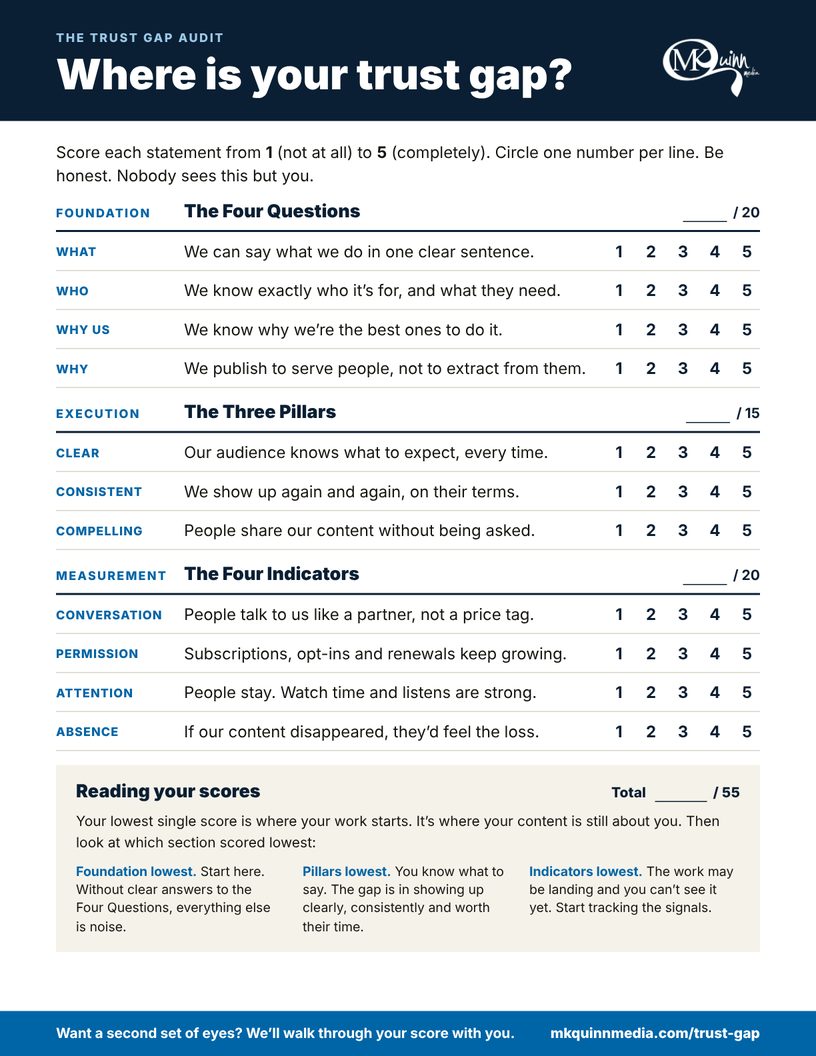
Preview of the one-page Trust Gap Audit scorecard

Free download

Score your own trust gap.

The one-page Trust Gap Audit from the keynote. Eleven statements, about ten minutes, and a clear answer to where your work starts.

  • The Four Questions, Three Pillars and Four Indicators on one page
  • A 1–5 score for each, with section subtotals
  • What your lowest score means, and what to do first

The real measure

It isn’t what you publish. It’s what they’d miss.

AI is producing more content, faster and cheaper, and most of it is about the brand. When anyone can flood every channel, the brands that win are the ones that make it about their audience.

Trust isn’t soft. It’s strategic. It’s the asset that compounds, and the one thing AI can’t manufacture for you.

The Trust Gap is also a keynote. Matt first presented it at Digital Summit Minneapolis in 2026.

Bring the talk to your event

Want help closing your gap?

Tell us where you scored lowest, or grab 30 minutes on our calendar. You’ll hear back from Matt directly.

Book a 30-minute call